

The Self-Knowledge No System Can Give You
Svadhyaya, self-study, and why yoga goes deeper than Human Design, astrology or personality profiles

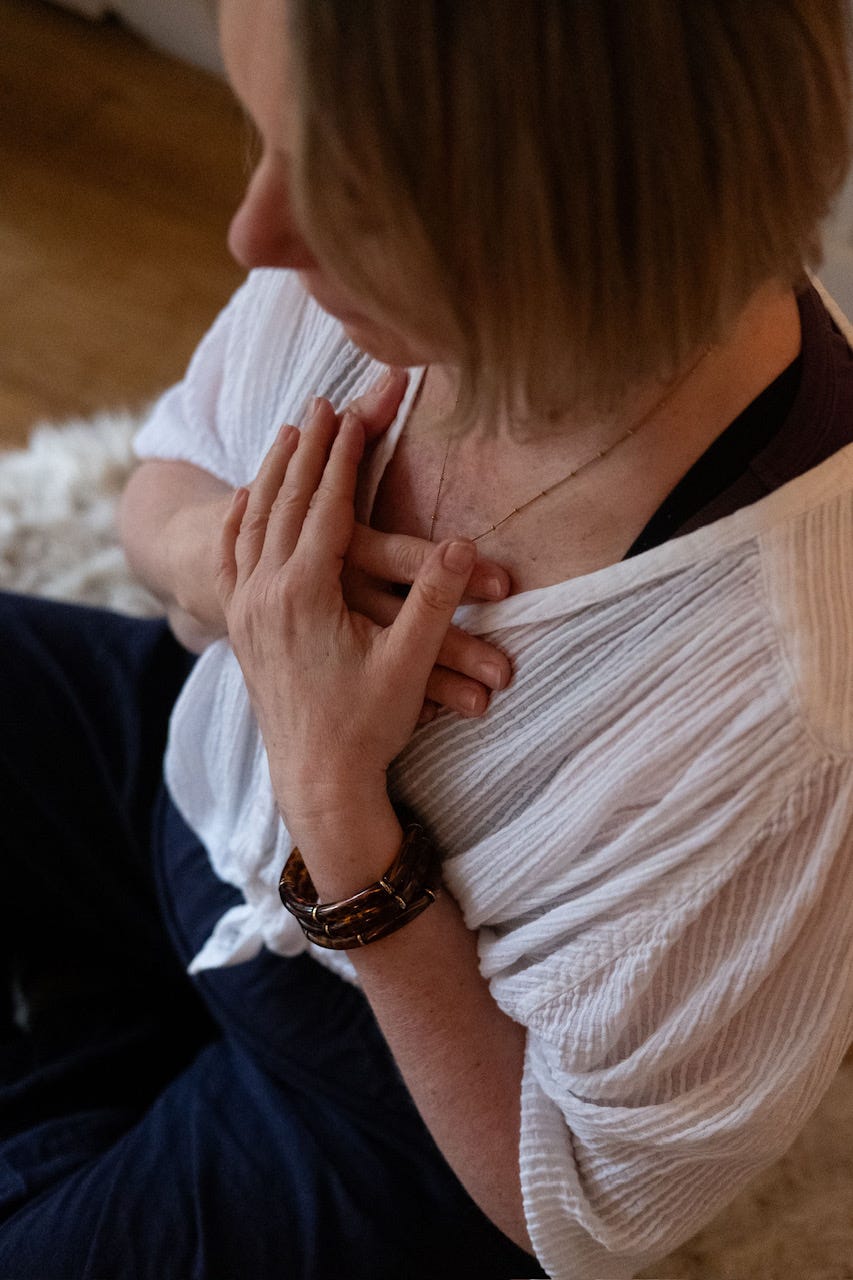
I don’t know if it’s just me, but I keep going round in circles at the moment. I’m a woman, in midlife, and a question keeps niggling at me – who am I? Underneath the decades of accumulated layers and identities? Who was I before… this? This woman who is superficially ok, but sometimes wonders what happened to that girl she once was.
Before I know it, I’ve lost an afternoon researching Human Design or the Enneagram or Gene Keys or astrology – the kind of frameworks you need a birth certificate to get a reading and that leave you feeling seen, validated and hopeful. Especially astrology. (As an aside: Did you know Carl Jung used astrology?).
These systems are fascinating, which is why I suppose I see every other yoga teacher adding them to their toolkit, why I keep being drawn to them – and probably why Jung was too. But I’ve started to notice that when I look to any of them for answers, they offer up a feeling of safe containment. Which is great – there’s a lot to be said for neat definitions. Who am I? A manifesting generator. A 4/6 profile. A Scorpio rising. (Intense, mysterious, magnetic? Yes please!). It always seems to be something positive that I can point to and say: yes, that’s me. Of course it feels validating.
But it’s not really me, is it?
It’s a way of feeling seen, yes, and perhaps helps me recognise my strengths and foibles too, in a way – but the categorisation does all the work for me. It’s a definition, but it doesn’t hold the full breadth, mess and complexity of my very human life.
Yoga philosophy takes a different approach. Rather than offering a system that tells you who you are, it offers a practice of finding out for yourself. There are no charts or personality types. Just a suggestion to be with yourself, quietly, and do the work.
What is svadhyaya? Self-study in yoga philosophy
The Sanskrit word for this is svadhyaya. It’s one of the niyamas – the personal observances in Patanjali’s eight-limbed path – and it’s usually translated as self-study, although as is often the case for translations from Sanskrit, the full definition is a little more nuanced. Because “study” implies a curriculum, a method, a body of knowledge to be acquired. Svadhyaya is quieter and more subtle. There’s no formula, training or certificate available on completion. Sometimes it feels as if there isn’t even an end to it. Svadhyaya, the study of the self, is a lifetime’s work.
Think of it as of a tuning in. Sitting still long enough to hear the frequency that’s yours.
It sounds simple, but when you've spent the best part of twenty years attuned to everyone else's needs – work, family, the ten thousand demands and the invisible labour of keeping everyone else's life on track – your own frequency gets drowned out. Turning the dial back to yourself feels clumsy at first. There's static. Noise. Sometimes ear-splitting interference or, perhaps worse, a deafening silence.
But, with persistence, you can fine tune the signal.
Svadhyaya and the Yoga Sutras
Classical yoga teachings offer us a starting point. In the Yoga Sutras, svadhyaya includes the study of sacred texts – not as an academic exercise, but as a mirror. You read not to acquire knowledge but to see yourself more clearly through what you encounter in these texts. None of us are literally Arjuna in the Bhagavad Gita, standing on the precipice of battle, with god as our teacher. But we are warriors in our own lives, and self-knowledge arrives when you're willing to ask the questions and then listen, just as Arjuna does.
You can extend this principle to any practice of honest self-observation: journaling, sitting in meditation, noticing your default habits on and off the mat. You're not looking for answers from outside. You're creating the conditions for self-knowledge to arise.
Self-knowledge in midlife
What svadhyaya tends to show, especially in midlife, isn’t what most of us expect. We brace ourselves perhaps for uncomfortable truths, for the emergence of things that have been buried for years that we’d rather not confront. And yes, sometimes that happens.
But often what emerges is something quieter. A sense of recognition perhaps, or a remembering.
Because underneath the roles accumulated over decades – the mother, the professional, the organiser, the one who holds everything together – there is someone who was there before all of that. Who has preferences and a particular way of articulating herself which became very quietly subdued over time. Svadhyaya allows her to stop, and take a breath. It creates enough space so she can find her voice again.
This is why no framework can do this work for you. These systems can tell you that you’re a manifesting generator, or a type four, or a Sagittarius moon. They can offer you a definition and a sense of agency over shaping your future – and I’m all for that. But what they can’t do is pay close attention. They can’t sit with the silence and wait to hear what emerges.
Only you can do that. And that, my friend, is the work. It is my work and it is yours, too.
A svadhyaya practice to try this week
This week's offering is a small practice of remembering.
Take a quiet moment to consider brought you joy as a child. Picture yourself back then. Imagine yourself doing that activity – it might be something you were good at, and you you were praised for it, but try to separate that out. What activity or thing did you choose to do, even when no one was watching, or praising?
Now find a little time this week to do that thing again. Tell no one. Do it just for you.
Next week, I'll be introducing The Living Compass – a reflective tool for exactly this kind of turning inwards. It will be available to paid subscribers of The Almanac Room.
Thank you for reading. A share costs nothing but helps spread the word.
If this piece resonated with you and you’d like to support my work without subscribing, you can also buy me a coffee. No subscription required, no strings – just caffeine and a huge amount of thanks from me.
Thank you for sharing this. Under the layers of life we do find ourselves again. What beautiful encouragement you’ve given, through this practice, to allow that discovery. Wonderful post Monika. Thank you.
This is a beautiful reflection, thank you.